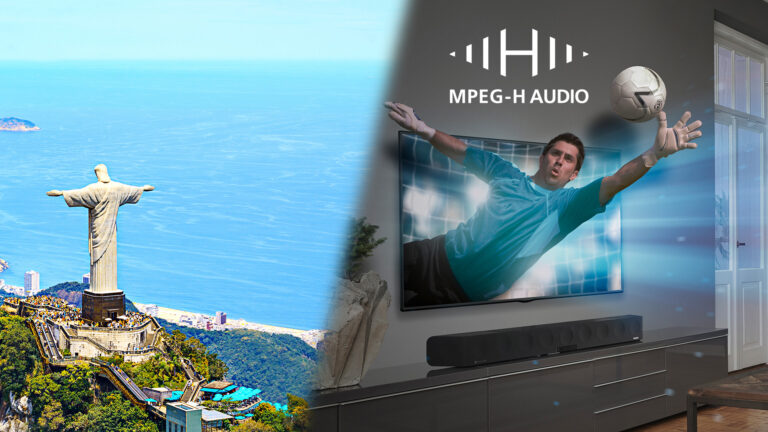
In Brazil, a major technological upgrade of the digital TV system is under way: The country has entered the commercial DTV+ (TV 3.0) era, with MPEG-H Audio now on air as the mandatory audio system of the country’s next-generation television platform. The launch is marking one of the most significant broadcast technology rollouts worldwide.
The next-generation system is being developed by the SBTVD Forum and builds on several years of successful testing and implementation. Initial tests were conducted during the 2022 World Cup in Qatar. As a transitional step, TV 2.5 already included MPEG-H Audio to enhance the user experience with immersive and personalized sound. Major Brazilian broadcasters, including Globo, Rede Amazônica, and TV Cultura, have partnered with Fraunhofer IIS to integrate the technology. Globo used MPEG-H Audio during the 2023 World Cup and is now broadcasting it 24/7. Rede Amazonica and TV Cultura have also launched continuous MPEG-H Audio services that make particular use of the technology’s customization options.
In April 2025, Globo launched Brazil’s first DTV+ pilot station in Rio de Janeiro, marking a major milestone. This station broadcasts experimental content using MPEG-H Audio, allowing for real-world testing and refinement. The pilot is part of a broader initiative led by the SBTVD Forum, with support from broadcasters, manufacturers, and government agencies. MPEG-H Audio was integrated into products through collaboration with Fraunhofer IIS, laying the groundwork for personalized, immersive audio in Brazil’s future TV landscape.
In June 2026, Brazil officially transitioned DTV+ (TV 3.0) from pilot deployments and regulatory preparation into commercial operation. The launch was intentionally aligned with the Soccer World Championship, providing an opportunity to deploy and validate the new broadcast system under real-world conditions during one of the largest live television events. Globo initiated 24/7 commercial DTV+ transmission, bringing next-generation television services to viewers in Rio de Janeiro, São Paulo, and Brasília, with further expansion planned across the country.
The commercial launch represents a significant milestone for the Brazilian broadcast ecosystem: By combining over-the-air delivery with broadband-enabled interactivity, DTV+ introduces new capabilities for content providers, advertisers, and viewers while maintaining free-to-air television as a core platform. To ensure access to the full immersive audio experience, the DTV+ standard mandates support for MPEG-H Audio over the HDMI connection of every DTV+ receiver. Commercial DTV+ receivers are already available in Brazilian retail channels, with early offerings available from Aquário, Intelbras, and Vivensis, and further TVs and Set-Top-Boxes (STBs) expected to enter the market in the following months.
Globo, the largest media group in Brazil, plays an important role in bringing new broadcast technologies to the market. Discover how their experts are working with MPEG-H Audio to deliver advanced personalization and accessibility options.
Globo uses MPEG-H Audio on their free-to-air commercial channels according to the SBTVD TV 2.5 standard. The media group drives the broadcast innovation in Brazil and carried out the first TV 3.0 showcase during the 2022 football tournament in Qatar.
MPEG-H Audio at Rede Amazonica
Grupo Rede Amazonica was the first broadcaster in Latin America to broadcast 24/7 with MPEG-H Audio on their Amazon Sat broadcast channel in December 2021. Their team share their experiences with the Fraunhofer technology.
After implementing MPEG-H Audio on their first channel, the broadcaster has now enabled MPEG-H Audio on their main broadcast channel to provide an enhanced audio experience to an even broader audience.
MPEG-H Audio at TV Cultura
TV Cultura has partnered with Fraunhofer IIS to evaluate the capabilities of the MPEG-H Audio system. They already enabled the system in their production workflows, emission encoders, and even opened a dedicated experience room where consumers can listen to MPEG-H Audio content and experience all benefits of the system.
Contact
If you have any questions, suggestions, or if you need further information, please do not hesitate to contact us. For more information, please contact audio-info@iis.fraunhofer.de or visit our website www.iis.fraunhofer.de/audio.