Broadcast & Streaming
Future-proof Broadcast and Streaming
Broadcasters and streaming services want to provide content with customizable, immersive sound to their increasingly fragmented on- and offline audiences. With MPEG-H Audio, it is now possible to deliver state-of-the-art 3D-sound that consumers can adapt to their preferences and requirements. Thanks to the advanced production process and tools, the increasingly popular technology can be implemented easily and without the need for substantial investments.
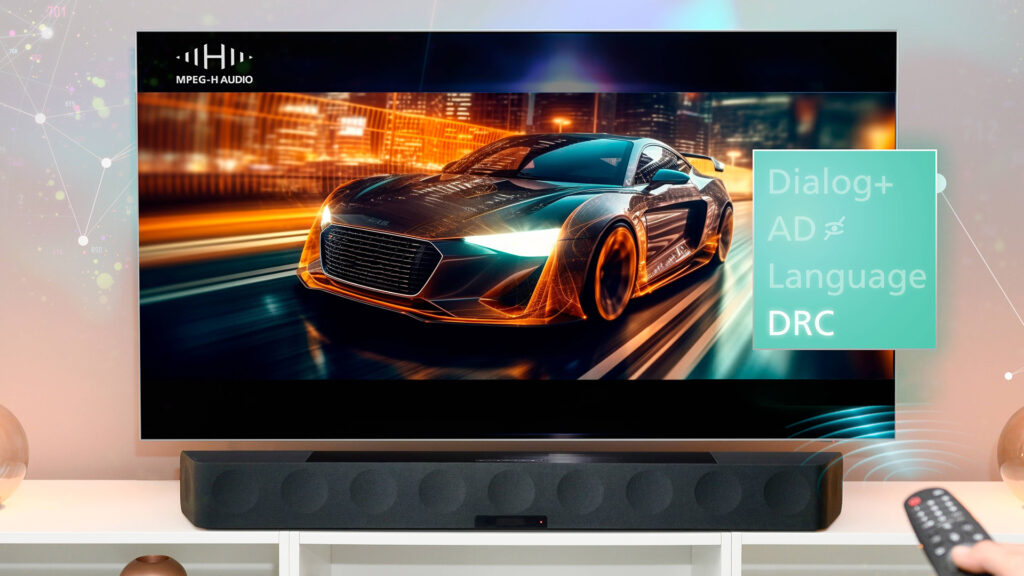
MPEG-H Audio goes beyond usual mixes: It delivers a unique, immersive sound experience that can be personalized through presets and flexible controls for audio objects like commentators and languages as well as advanced accessibility options including audio descriptions and dialogue enhancement.

Maximum Accessibility
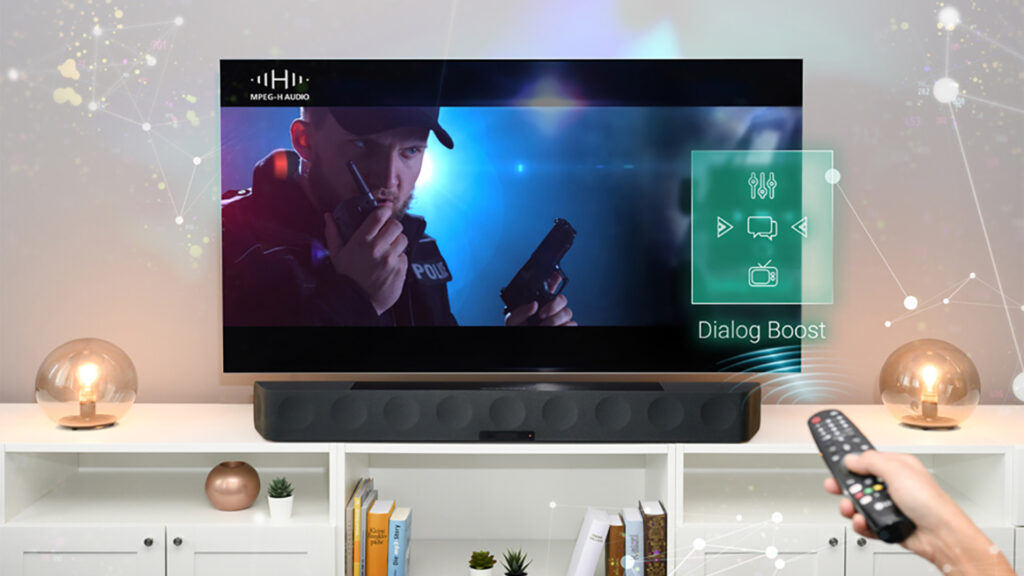
Providing accessible content to the widest possible audience remains a central challenge for today’s broadcasters and streaming providers, who must ensure that speech is intelligible and that additional accessibility features are seamlessly integrated into existing production workflows. MPEG‑H Audio addresses these challenges with a comprehensive toolset designed to automate and enhance accessibility, enabling creators to adapt the loudness balance between dialogue and background elements and to enrich new productions with alternative language versions, simplified language, and flexible accessibility options.
Dialog+ Enhances Speech
Many viewers struggle to follow dialogue due to overpowering background sounds, and studies confirm that speech intelligibility varies greatly among audiences. To address this, The Dialog+ production technology processes legacy content using deep‑learning‑based dialogue separation and automatic remixing to produce clearer, more understandable speech while preserving artistic intent. Complementing it, MPEG‑H Audio elevates Audio Description by delivering the narrator’s voice as an adjustable audio object whose level and spatial position can be tailored to user preferences, and because this object‑based approach extends from stereo up to fully immersive formats, it ensures that visually impaired audiences receive an optimal listening experience across all devices, with AD integrated directly into regular transmission and easily selectable as a preferred preset.
Language Selection
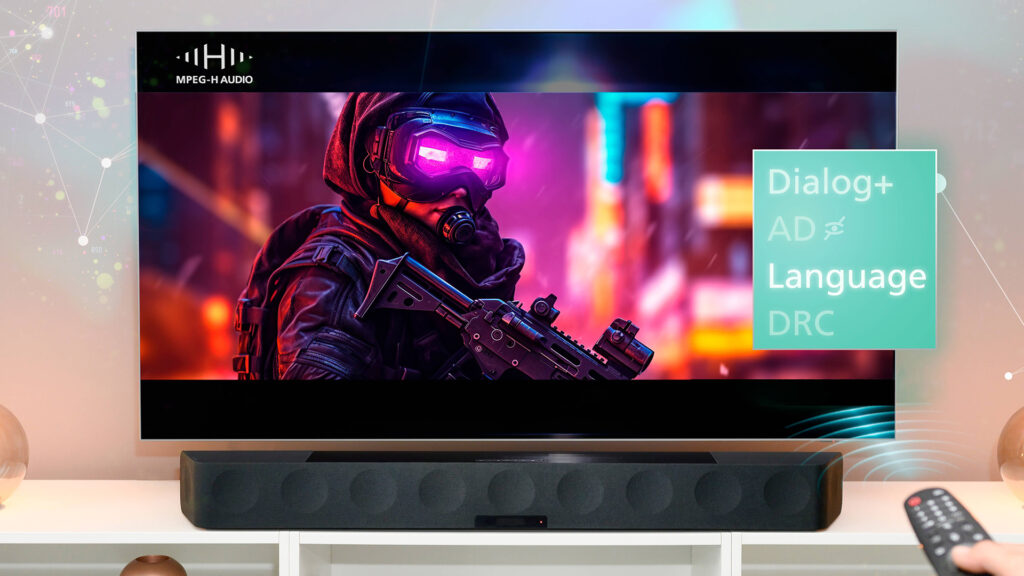
Many of today’s TV shows and films are created with an international audience in mind. Traditionally, however, each language version requires its own data package. This can result in the amassing of data on providers’ servers and complex selection and switching processes for user and provider alike.
With MPEG-H Audio, it has become easy to author, deliver, and archive content with multiple languages or dialogue versions. Creators simply add an additional audio component to their audio scene, which can be selected automatically by the end device or manually by the user. All audio versions can be grouped together with one video. This results in huge data savings, enables providers to create new offers for their audiences, and can improve the selection process for viewers.
Seamless Control
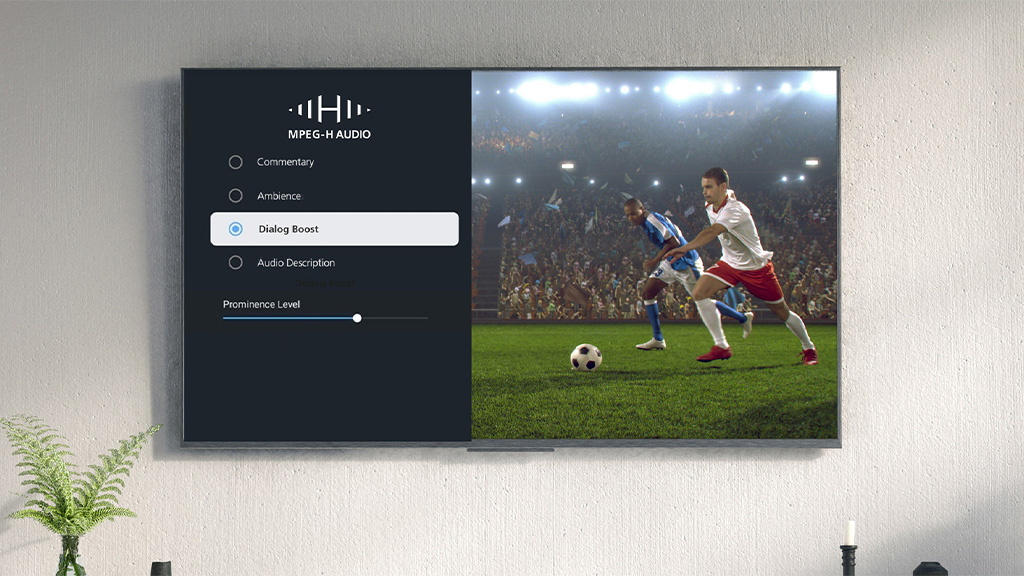
Tomorrow’s broadcast experiences are all about customization. MPEG-H Audio enables you to deliver the smooth audiovisual experience your viewers expect. Ad replacement can be synchronized down to the video frame, content can switch back and forth between channel formats, viewers can change commentators or languages – all without glitching, restarting the stream, or unexpected playback control pop-ups. MPEG-H Audio metadata lets you update UI elements dynamically, presenting only relevant presets and controls to your viewers.
Effortless Consistent Loudness
No matter if it is within or between programs – consistent loudness levels are essential for a coherent user experience and ease of listen. MPEG-D DRC brings the entire audio mix including speech to a consistent level and it provides an optimal dynamic range for any playback device, environment, and user preference.
In a living room, for example, the content can be enjoyed with the full dynamic range, the way the mix was intended. In a noisy environment, the dynamic range can be reduced for improved speech intelligibility and listening comfort. This makes frequent manual volume adjustments a thing of the past.