
Brazil moves DTV+ into commercial launch in time for the Soccer World Championship – and brings MPEG‑H Audio to the forefront. The new one-of-a-kind system enables immersive, interactive, and personalized viewing, with live sports set to showcase next‑generation broadcast capabilities at scale.
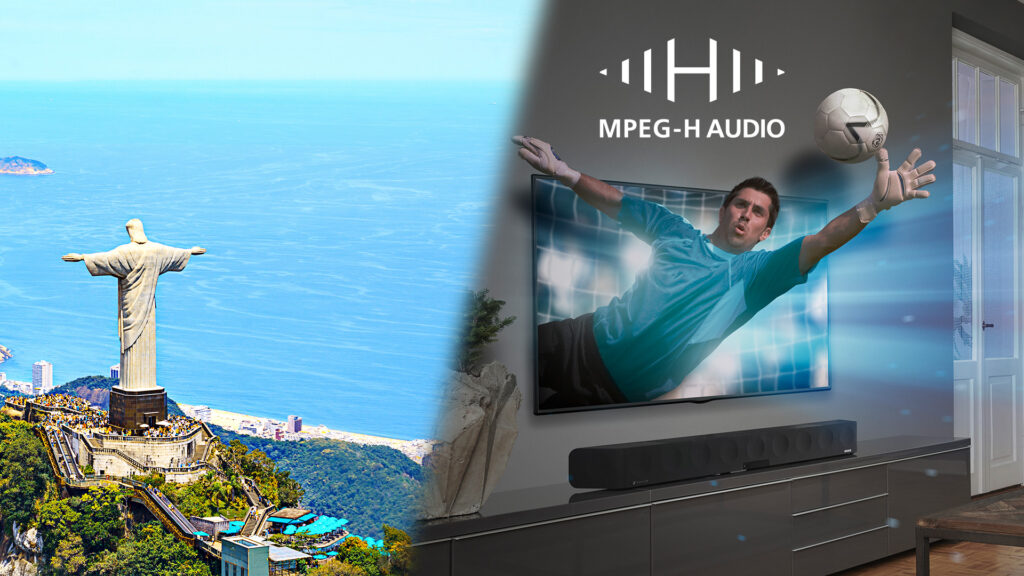
MPEG‑H Audio Brings Personalization to Live Sports
Broadcasts of the Soccer World Championship will serve as a groundbreaking use case for MPEG‑H Audio in a terrestrial environment. Globo is set to play a central role in this phase, initiating 24/7 commercial DTV+ transmission, also known as TV 3.0, and transmitting soccer matches over DTV+, leveraging MPEG‑H to enable advanced user-driven audio control.
Unlike conventional broadcast audio, MPEG‑H allows viewers to adapt the sound mix in real time. This includes options such as adjusting the balance between commentary and stadium atmosphere, enhancing dialogue clarity, or selecting alternative audio feeds. For live sports, these capabilities introduce a more flexible experience tailored to individual preferences and viewing contexts.
By aligning deployment with a globally relevant sports event, the Brazilian ecosystem is effectively deploying an end-to-end implementation – from production workflows to consumer playback.
Transition to Commercial Operation
“TV 3.0 is the union of over-the-air transmission – broadcasting – with internet access. For the population, the immediate benefit is having richer, more immersive content tailored to their preferences. This is a TV for Brazilians and made by Brazilians.” – Marcelo Moreno, Counselor, SBTVD Forum and Professor at UFJF. (Journal Nacional – Portuguese)
The commercial launch of DTV+ marks the shift from regulatory preparation and trials into continuous broadcast service. For the broadcasting industry, this represents a major milestone, benefiting content producers and advertisers. By combining traditional over-the-air delivery with broadband-enabled interactivity, DTV+ brings a new dimension to the overall television experience.
The rollout begins in Rio de Janeiro, São Paulo, and Brasília, with gradual expansion planned across the country. Coverage is expected to reach 15 major capital cities by 2030.
“Today, free over-the-air TV is one of the main forms of entertainment for the Brazilian population. It is worth noting that this technology will operate in parallel with current digital TV technology, but the additional services will be available to the population through internet access connectivity.” – Frederico de Siqueira Filho, Minister of Communications (Jornal Nacional – Portuguese)
New Capabilities for Broadcasters, Advertisers, and Viewers
DTV+ introduces a framework that revolutionizes traditional broadcasting in Brazil and the world. For viewers, the system supports richer and more interactive content, including personalization enabled through MPEG‑H Audio.
For advertisers, the hybrid broadcast-broadband model enables more granular targeting and interactive campaign formats, such as those implemented through Globo Ads. Content producers, in turn, can extend audience engagement through additional layers of interactivity and adaptive content presentation.
These capabilities depend on both network infrastructure and receiver support, making ecosystem alignment a critical factor in early adoption.
Receiver Ecosystem Takes Shape
Commercial DTV+ receivers are already available in Brazilian retail channels, with early offerings available from Aquário, Intelbras, and Vivensis, and further TVs and Set-Top-Boxes (STBs) expected to enter the market in the following months.
All major TV and STB manufacturers have joined the MPEG-H Audio Trademark Program, which is an essential step for the successful deployment of the system. Certification under the MPEG-H Audio Trademark Program guarantees interoperability and compliance with the standard, giving manufacturers and broadcasters confidence in seamless integration.
To ensure access to the full immersive audio experience, the DTV+ standard mandates support for MPEG-H Audio over the HDMI connection of every DTV+ receiver. This will empower MPEG-H enabled Soundbars and AVRs to be part of the DTV+ ongoing technological revolution.
With transmissions on air, devices on shelves, and the world’s biggest sports audience tuning in, Brazil’s DTV+ launch is a milestone the global broadcast community will be watching closely.